Selling to Gen Z in Grocery
Personalization, without the creepiness.

Saptarshi Nath
Most grocers have realized by now that Gen Z doesn’t fit the buying patterns they’re used to. Generic messaging won’t encourage them to shop with you. Discounts that work for Gen X fall flat with Gen Z.
So what’s going on?
And what do we do about it?
The core mistake: Treating Gen Z like one big group
The first mistake grocers make is to think of them as a homogeneous group. Every Gen Z individual is just that… an individual.
Each Gen Z shopper has a unique profile: one might be a gym enthusiast who works out daily and prioritizes healthy eating, while another could be a busy finance professional with barely any time to eat between meetings. A generic “30% off this Saturday” doesn’t speak specifically to either of them.
Personalized messaging is essential, but personalization in 2026 works completely differently.
Why old-school personalization fails in 2026
Millennials are the last generation that saw the evolution of technology from floppy disks to ChatGPT. Gen Z is native to it. They can tell at a glance whether your email or text is genuinely personalized.
Your marketing agency that sends “Hi {first_name}, we saw you bought {product_1}” emails is not ready to take on the challenge. Such messages sound robotic and send the signal that you don’t truly understand your shopper. You have potentially years of purchase data on the shopper; is customizing the name the best you can do?
Most executive decks today call out this segment as a key priority but fail to take concrete steps to engage with this audience. That is because they are not putting all the data to good use. It isn’t surprising: your best business executives can’t be expected to be data wizards at the same time.
So let’s look at how to get started.
What Gen Z actually prioritizes (and what they don’t)
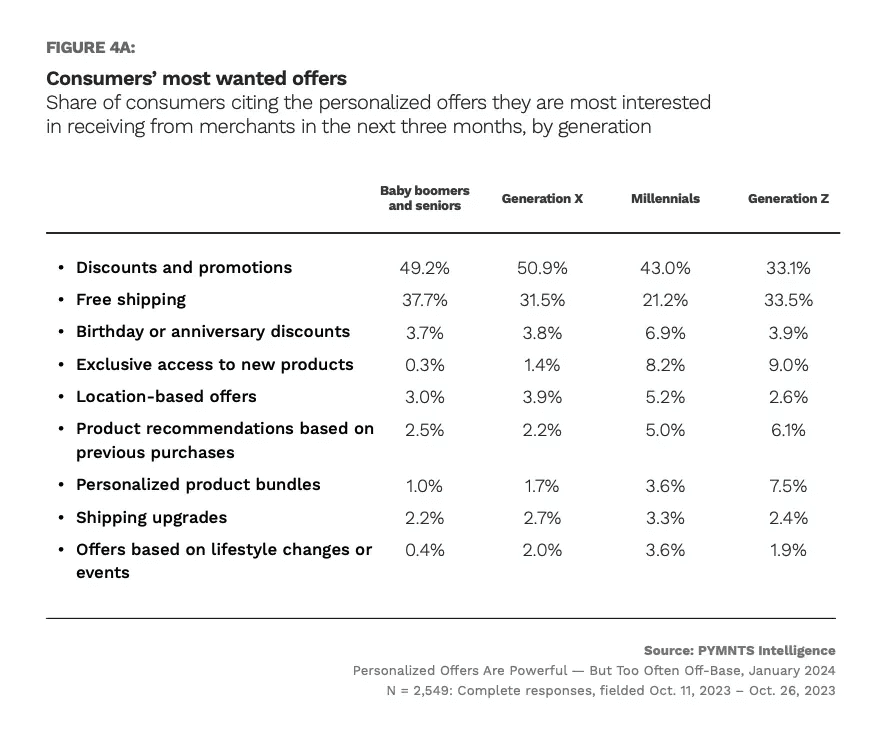
The reality is that Gen Z doesn’t prioritize the same things other generations do. In fact: while half of Gen X cares about discounts and promotions, 67% of Gen Z don’t.
What do they care about then? They care about exclusive access, recommendations, and cross-merchandizing that demonstrates that you truly understand them.
What a Gen Z grocery “mission” looks like
Before you can understand the Gen Z perspective, you have to understand how Gen Z shops, what they shop, when they shop, how much they spend, and influence those micro-moments that make the Gen Z shopper notice that you’ve been paying attention.
Most grocery systems were built around the big weekly shop: one primary buyer, one trip, one cart, one long receipt. Gen Z doesn’t live that way. Their grocery missions are small, fluid, and collaborative. A “trip” might start with a roommate texting a list, continue on Instagram where recipes surface, and end with a mix of quick-delivery, convenience store, and a late-night visit to a discount grocer.
The same person might buy protein bars and kombucha as a health flex, instant noodles at 11 a.m., and the cheapest possible staples when rent is due.
Different engagement channels blend into one another: Gen Z shoppers discover on social, coordinate on WhatsApp, price-check on apps, and still walk into physical stores when they want control or immediacy. Any AI that assumes a stable household, a fixed schedule, or a neat monthly budget is already misaligned with how their lives actually work.
But most importantly, don’t forget the most important commandment of all:
Thou shalt not be creepy.
Sign up for our insights
Where AI feels like service, not surveillance
AI is not a feature to Gen Z; it’s just an intelligent engine driving their experience.
The system must remember that they buy oat milk every 10–12 days and make it easy to add, without promoting how well it knows them. It must surface a cheaper equivalent when prices spike, or flag that a favorite item is low in stock before they head to the store.
The right AI is context aware and light-touch.
Design principles for trust-first AI journeys
Designing AI-powered journeys for Gen Z requires an unfashionable constraint: restraint. Don’t overdo it.
Use fewer signals, but use them more thoughtfully. Make the value exchange explicit: what data you collect, what they get in return, and how they can opt out. If you can’t explain the personalization benefit in one sentence that sounds like genuine help (”we use your past baskets to save you time on repeats and show cheaper equivalents”), you’re overreaching.
Introduce mission-based flows (“you’re restocking dorm basics,” “you’re hosting a movie night”), transparent savings and substitutions, and in-context prompts, sent at the right time through the right channel.
Think of it this way: if you stripped out the AI, would the journey feel obviously worse for the shopper; or would it feel about the same, just a little less creepy? If it’s the latter, you do not have a Gen Z-ready AI experience yet.
“Easier said than done” (and why it’s actually doable)
I know what you’re thinking: easier said than done.
Fortunately, grocery is a high-velocity market with thousands of orders per store each day; the data to make these decisions already exists. Your POS and loyalty program databases contain enough information to build effective segments and personas, enabling you to craft the right offers and messaging for your shoppers.
If you are considering hyper personalizing your communication with Gen Z shoppers, reach out to us now.