Why AI Projects Fail
...and how to make sure yours doesn't.

Saptarshi Nath
If you were a senior executive in a billion dollar company right now, would you take on a new project if you knew that there is a 95% chance it would fail?
And yet, enterprises around the world are throwing money at AI initiatives and hoping something works.
But if you could ensure a 80% chance of success by simply following a few hygiene steps, this could be your biggest career break ever.
I personally don’t think AI is all smoke-and-mirrors: not in quite the same way as Web 3 and altcoins. AI is going to define the futures of not just enterprises and startups, but also the way our daily lives look.
Let’s first look at why AI projects are failing today: not because there is something wrong with the technology, but because the rest of our systems, processes, and people are not ready: our data systems are not ready for AI, our spreadsheet-based processes are outdated, and our people don’t know what to do.
Why do AI projects fail?
MIT research found some very interesting findings, collated from feedback from 350 employees and 300+ AI deployments.
4 out of 5 top reasons for failure have nothing to do with artificial intelligence at all: these reasons would remain the same even if you were to implement another complex technology.
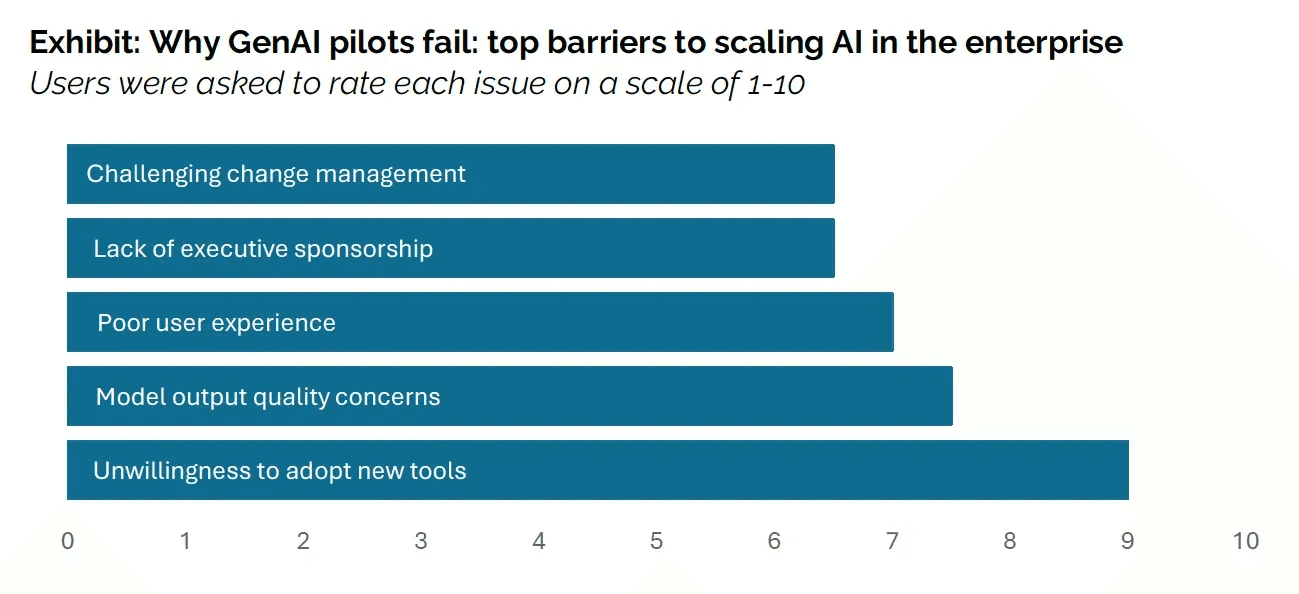
Let’s deep dive a bit into the root causes:
Companies fail to turn pilots into business impact. Despite high adoption rates, most AI initiatives stall in the transition from pilot to workflow, delivering little or no measurable P&L impact. Only 5% reach production.
Companies fail to build AI that learns and adapts. Most AI tools don’t retain feedback or improve over time. They remain static, stuck as MVPs, and never become business-critical because they can’t adapt to real-world operations.
Companies fail to win employee trust for new tools. Workers often bypass sanctioned AI projects and use familiar consumer tools instead. Internal solutions are seen as inflexible or misaligned, fueling a “shadow AI” economy.
Companies fail to put budget behind real ROI use cases. Budgets gravitate to flashy sales/marketing tools or “innovation theater” pilots—a pattern that neglects less glamorous, but higher-ROI, back-office and operations projects.
Companies fail to integrate AI into real workflows. The biggest technical blocker isn’t model performance—it’s lack of integration. Homegrown solutions break at the edge, while vendor tools rarely fit company-specific workflows out of the box.
Companies fail to empower the right champions (both internal and external) for adoption. Success hinges on line managers and frontline innovators, not central labs or C-level sponsors. Organizations struggle when they rely only on top-down mandates, missing out on grassroots experimentation and workflow-specific customization. Projects run by specialized external vendors succeed 67% of the times, where those run through internal teams are successful only 33% of the times.
What should companies do then?
Enterprises need to sort out the basics first. Assuming that an AI designed for enterprise will work just like chatting with ChatGPT is setting the wrong expectations. A wrong decision based on incorrect learnings from AI can be disastrous for a business, so we first start with defining the problem to solve and give the AI the right data to help solve that problem.
Focus on Fewer, High-ROI Use Cases and Scale Fast
Companies must move beyond scattered pilots and concentrate resources on a few high-ROI use cases. Top performers typically focus efforts on two to four business-critical initiatives, enabling disciplined piloting, clear performance measurement, and fast scaling when results are proved. BCG and McKinsey’s research highlights that spreading investments too thinly leads to wasted time and poor ROI.
Here’s how effective companies approach this:
Prioritize by impact and feasibility: Map all potential use cases, then rigorously score each on financial impact, ease of implementation, and data readiness. Only projects with clear business metrics and the potential to scale should move forward.
Invest in proven domains: High-impact areas include demand forecasting, automated inventory management, dynamic pricing, supply chain optimization, and personalized marketing.
Case in point: Walmart
Walmart has embedded AI and automation (robotics, machine learning, real-time analytics) across its supply chain, improving fulfillment, inventory visibility, and reducing delivery costs per order by 40%. These systems also accelerate delivery (45% of e-commerce orders delivered in under an hour) and optimize replenishment decisions.
By focusing on fewer, high-value use cases—and scaling what works—companies see measurable results and avoid the dilution trap that derails most AI projects.
Invest in Data Quality Early
Here’s what’s happening in practice: Retailers, especially independents and regional chains, often inherit a patchwork of systems as they scale. Team members pull daily sales from one dashboard, inventory from another, and loyalty performance from a third. Sometimes these numbers don’t even reconcile because each source is managed—and often owned—by a different provider.
For example, the POS data might be stored by one vendor (say, NCR or Square), while the CRM or loyalty provider could be someone like Dunnhumby or Salesforce. Loyalty transactions might show up in the POS sales history but never sync back fully to the actual loyalty platform. Or vice versa. The result is messy—marketing can’t segment properly, stores can’t track true customer lifetime value, and insights are out of sync.
When a retailer tries to launch an AI project, these fragmented sources don’t just slow things down—they can stall or completely derail the implementation. Data engineers spend months just mapping, cleaning, and joining hundreds of tables, by which point the use case or priority might have changed internally. I’ve seen cases where teams lost momentum simply because everyone got tired waiting for “the one true dataset” to finally materialize.
Without fixing the core data architecture—getting all the sources talking, clarifying who owns what, and agreeing on formats—AI transformation is usually dead on arrival. This is where the big players, who’ve invested in integrating data across channels and partners, pull ahead while the rest are still reconciling spreadsheets.
Embed AI in Every Process Without Forcing Behavior Change
Most retailers fail with AI because they treat it as a side project—just another dashboard or “innovation lab” tool that sits outside daily routines. True impact only comes when you embed AI into the processes and platforms that teams already use. Instead of requiring store staff or marketing managers to jump between new apps, leading retailers bring AI directly to their POS, CRM, or supply chain systems.
Sephora, for example, integrates AI-driven recommendations directly into its app and in-store kiosks, giving customers instant, personalized suggestions as they shop. Frontline staff and shoppers don't need to “use AI”—it just works behind the scenes, driving conversions and boosting loyalty. That’s what makes adoption organic and impact visible: AI meets staff and customers where they already are.

Sign up for our insights
Empower Frontline Experimentation
Retailers that win with AI don’t just rely on IT or outside vendors—they build internal muscle and give frontline teams room to experiment. You get the most impact when your store managers, marketers, and planners can test small AI projects in their own workflows, learning what actually moves the needle. Instead of waiting for head office to roll out a “big bang” system, the best brands hand tools, data, and training to line managers and let them spot opportunities and share results.
Accenture found that only 12% of global companies qualify as “AI achievers,” and these outperform because they grow talent in every business unit—not just in technology teams. For example, Tesco set up a “Test and Learn” program: local teams pilot AI for store ordering and promotions, then scale successful approaches chain-wide. This culture fosters real buy-in, uncovers sticky problems, and drives rapid improvement.
By empowering the people closest to the customer—and giving them freedom to try, measure, and share—retailers turn AI from a top-down experiment into an every-day habit. That’s when real transformation happens.
Build with Partners that Understand Both AI and Your Business
Easier said that done. Most legacy partners are still struggling to adopt AI themselves, let alone help your retail business implement AI. The most effective retailers balance core in-house expertise with high-value partnerships, letting them access proven technology, speed up delivery, and reduce risk.
Customization matters in retail because every chain operates its own mix of formats, customer segments, and legacy technology. Off-the-shelf AI tools rarely mesh with a retailer’s real processes or messy data. Your partners must understand how your costs, discounts, product margins, and customer behaviors work together.
How do you identify if an AI partner is right for you? I will deep dive into this in my next newsletter, but here are a few pointers:
Do they understand your business?
Do they bring an understanding of AI, machine learning, retail, and more innovative sectors like e-commerce?
Do they ask you the right questions? Or do they jump into solving the problem?
Do they question your current way of doing things?
—
AI is an once-in-a-generation leap in technology that we are lucky enough to experience. Like all such leaps, we can fight it or we can use it to our advantage. We need to take a step back and assess what truly matters to the enterprise before taking on AI projects that may lead nowhere.
If you need to talk to an expert, find a time with the Goodlight team here. We will be happy to delve deeper into AI opportunities for your business.