Demystifying AI for Independent Retailers
Understanding artificial intelligence, defining buzzwords, and highlighting why regional retail chains should pay attention.

Saptarshi Nath
At Frank’s Fresh Markets, the best-selling olive oil was flying off the shelves after a big discount. What started as a two-week deal quietly stretched into months. Nobody noticed—the promo tag just lingered in the system, draining profit with every bottle sold.
Six months went by. Each day, the store bled more money. Staff thought the sale had ended. No alarms. No warnings.
In the shadows of everyday routine, one small oversight nearly turned into a silent disaster.
This is a hypothetical scenario… but very likely. It could be happening to your retail stores too, without you being aware.
These are just the scenarios where AI shines. With a trained AI model watching your transaction logs, it would have flagged an anomaly when discounts crossed normal thresholds.
Today we deep dive into what AI is, and what it can do for you, without (too much) jargon.
Why Even Talk About AI Now?
Unless you’ve been living under a rock, it is impossible today to avoid hearing about AI—about how the work we do is going to change forever, how our lives are going to change, and how we’re all going to lose our jobs.
AI dominates all business discussions today—independent retailers are hearing about AI from every source. But AI is much bigger than just Grok, ChatGPT, or Claude.
Today, I’ll break down what AI actually is and what it means for you as a retailer.
What Actually Is Artificial Intelligence?
Think of AI as computers doing things that usually need human intelligence, like solving problems, making decisions, or finding patterns. Here are some real-world examples:
Virtual assistants like Siri or Alexa can answer questions, set reminders, or play music, just by listening to your voice.
Streaming services like Netflix or Spotify suggest movies or songs you might like, based on what you’ve already enjoyed.
Google Maps uses AI to find the fastest route through traffic, often better than a person could.
Chatbots on websites answer customer questions at any time, even late at night.
AI is not the same as old automation tools. Old tools just followed set rules—if this happens, do that. But today’s businesses are too complex for simple rules. Now, AI bots (often called agents) can learn about your business and figure out the best way to handle challenging tasks, just like a human would—only much faster.

Sign up for our insights
Key AI Concepts and Terminology Retailers Should Know
Artificial Intelligence is an umbrella term for multiple areas: Tesla uses AI to drive cars, Netflix uses AI to recommend your next show, and ChatGPT uses AI to answer your curious questions.
When you read about AI, you will hear two words often:
Machine Learning—Such systems learn from data to make predictions or decisions (like predicting how much of a specific inventory you need to reorder).
Large Language Models—Such systems are trained on text datasets and are useful for language tasks (like writing an article).
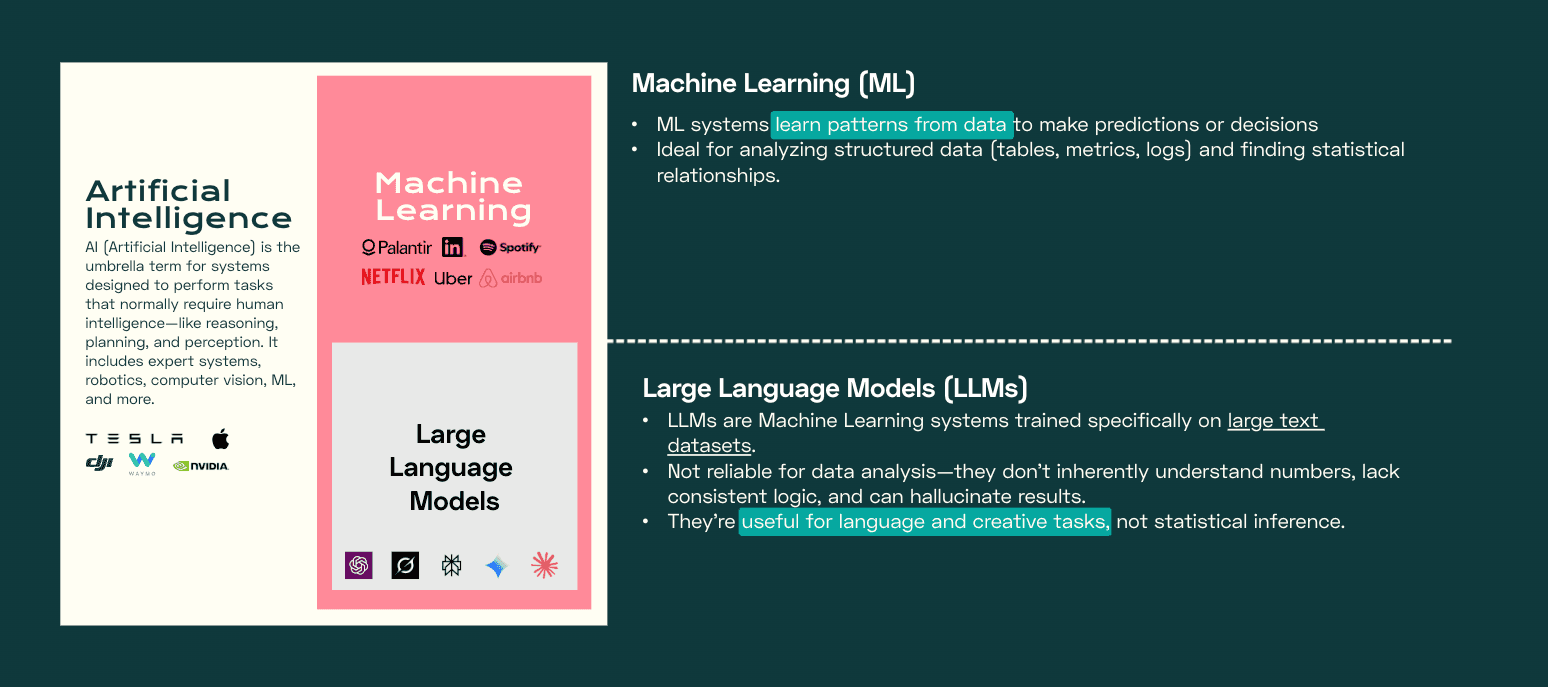
Every AI system learns from data—both public and private. If you have unique data, like millions of transactions from your grocery stores, you have a real advantage. You can use this data to drive smarter, AI-powered decisions in your business. As with most technologies, the quality of AI is only as good as the training data you provide.
Why Should Independent Retailers Care About AI?
Independent retailers are already under pressure: margins are slim, talent is sparse, and customer preferences are changing. AI is no longer an optional extra. Retail chains are well poised to take advantage of AI to meet existential challenges: even independent retailers.
Big box retailers already know the impact AI can have: companies like Kroger have invested heavily in AI and prediction models (through its acquisition of 8451 and Market6). With the right support, Independents can achieve the same outcome at a fraction of the cost.
Independent retailers can use AI to improve margins (by forecasting inventory accurately, managing scheduling to optimize staff availability) and increase revenues (by understanding customer preferences more accurately, managing pricing and TPRs efficiently). Watch out for my next newsletter where I deep dive into how Independent retailers can make the most of AI.
How to Start Thinking About AI in Your Retail Business
Adopting AI can’t be shoved down an organization’s throat. You can’t make an announcement that your team is going to be AI-first and expect everyone to follow along.
It isn’t so much a change in process as it is a change in culture. It impacts how decisions are made and which roles become more critical. More importantly, it changes the expectations from every team member.
If you are a leader at a retail chain, you need to promote a mindset shift instead of demanding action right away.
The biggest mindset shift is that you don’t need to have all the answers… but you need to know which questions to ask.
Give your leadership team access to an AI tool like ChatGPT or Perplexity. For just $20 a month, they can see firsthand what AI can do. Let them learn the basics early, before making bigger investments. This way, they’ll know what to ask when vendors promise to “transform your business with AI.”
There are also many AI adoption courses available today. While they tend to be more general, and not targeted towards independent retail and grocery, watch this space—there may just be a course for this very vertical in the near future.
Build Curiosity Within Your Team
Yes, AI is going to change the way the world works. But such big shifts have happened many times before: think about when calculators first appeared or when the iPhone launched.
Twenty years ago, no-one expected we’d spend so much time on our phones. Now, it’s tough to find someone without a smartphone.
Five years from now, you can’t afford to be the person that refuses to leverage AI. The good news is: adopting AI is easier than moving from an iPhone to an Android.
So take the first steps and start building the curiosity and willingness in your teams. Get them using AI to build a level of comfort.
The world-changing ideas will come naturally.