The Essence of the "AI Revolution" for Grocers
AI companies are approaching grocers all wrong. Here's why.

Chris Greco
"We're revolutionizing grocery with AI!,” said the start-up CEO.
The grocery chain VP was staring at him, caught between a sigh and frustration. The $75k pilot program wasn’t showing results and the timeline remained unclear.
The VP’s eyes glazed over. He said 100 words without speaking a syllable. This was his third AI pitch this month.
The startup CEO froze. His "game-changing" inventory optimization reduced to Silicon Valley babble.
I've either lead, participated or observed 300+ technology pitches to grocers. Here's what nobody tells AI founders about selling to grocers (esp the larger billion dollar chains):
Your "innovation" is their "margin risk."
Your "disruption" is their "inventory danger."
Your "revolution" is their "customer churn."
The Hard Truth About Grocers
While other industries embrace AI at breakneck speed, grocers can move like they're carrying eggs; AND FOR GOOD REASON.
One algorithm mistake doesn't just crash a website. It impacts an already low ~1.5% net margin. It can miss orders. It can damage their community brand in a world where big box operators - like Walmart and Aldi - are taking more share from the community stores.
Grocers aren't slow adopters—they're careful adopters. There's a difference.
The grocery executive thinking - "Who wants to be the first penguin in the water?" -isn't being difficult. He’s being responsible. Now this doesn’t mean they shouldn’t move faster. I 100% think they should, especially when there’s trust, but that’s for another article.
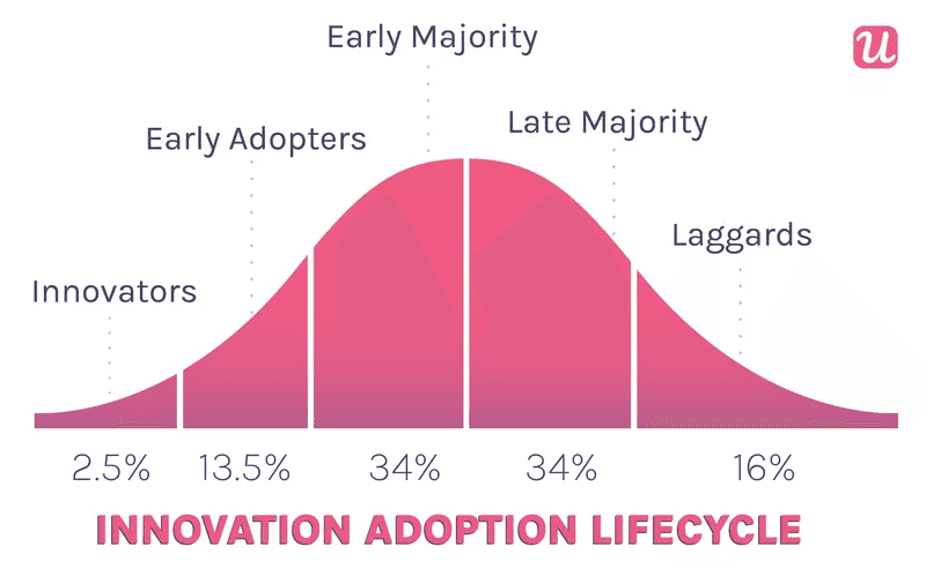
However, all of them do fall into one slot of this curve, and some may argue more so into the late majority and laggard categories. In the AI era, I would argue grocers would be wise to increase their risk tolerance even one-level and test what AI, from responsible AI companies, can do for them.

Sign up for our insights
The Three Types of Grocery Buyers
There’s another way to view the buying behavior of this industry. The larger grocers are “Enterprise Buyers.” After analyzing hundreds of grocery decision-makers, the categories to which they fall may look something like this -
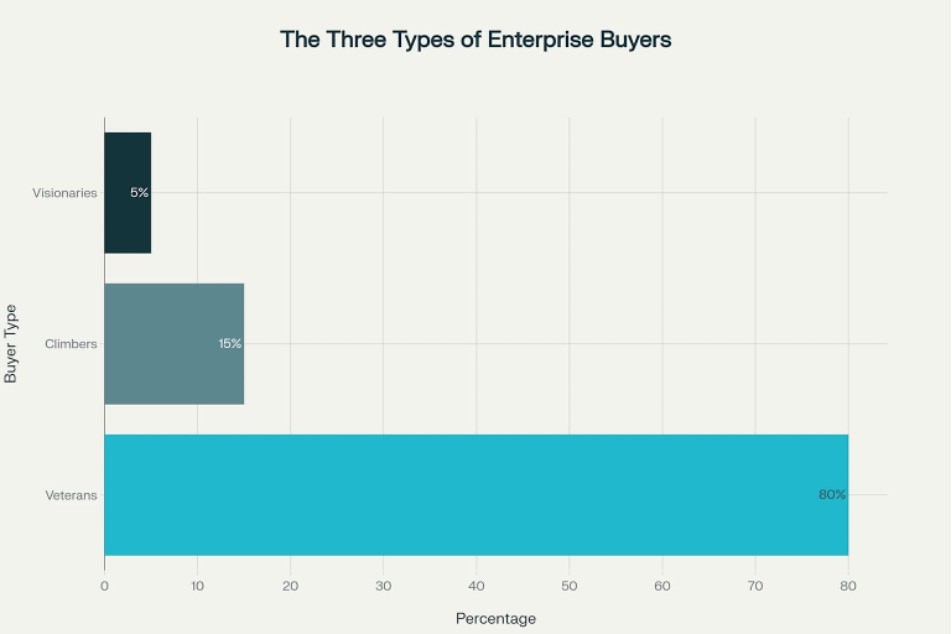
Understanding these nuances is crucial for selling value into this industry.
The Veterans (80%):
Survived recalls, supply shocks, and razor-thin margins
Want stability above all else
Need proof, not promises
Buy from safety signals
The Climbers (15%):
Chase calculated wins that advance their careers
Need evidence, not excitement
Buy from success stories
Won't risk their reputation on unproven tech
The Visionaries (5%):
Build the future quietly, behind the scenes
Need substance, not show
Buy from deep insight
Understand that competitive advantage comes from better operations
What Actually Works
Last month, I witnessed a pitch on "AI-Powered Demand Forecasting” to a major chain.
The buyer's real thought? "Great. Another system that might tell me I need more bananas."
After working with 1,000+ food retailers, here's the secret:
Don't pitch revolution. Pitch results.
Don't promise the future. Prove the present.
Don’t act like a vendor. Be a partner sharing the risk.
Because in grocery, the most dangerous reply isn't "this won't work,” rather you’ll hear "let me think about it."
And the “let me think about it" is what you get when you over-subscribe to grocers with “innovation” or “disruption” without conveying how your AI platform (or technology, or product) fits within the way they operate today. This doesn’t mean they won’t evolve over time, rather they will when your value becomes apparent.
The Bottom Line
AI in grocery is not about disrupting everything. It's about improving what’s essential, solving one problem at a time.
Every SUCCESSFUL grocer shares an important, strategic trait: they invest when the data, coupled with their intuition, is clear.
In grocery, it’s not so much about AI as a revolution — it’s about using AI as a strategic edge to future-proof your business.