If I Remove The AI, Does The Company Still Function?
The essence of being an AI-native company.

Chris Greco
Every few decades, an industry gets reshaped not by what’s added; but by what’s born in.
Tesla wasn’t the first automaker to build an electric car. GM’s EV1 arrived in the 1990s, Ford had early hybrids, and nearly every OEM had prototypes. But Tesla was electric-native.
It never had to protect an engine business or retool factories designed for pistons and tailpipes. It designed the car around a battery, the software around data, and the company around continuous updates.
The result: in 2024 Tesla’s automotive gross margin hovered near 17%, more than double GM’s 8% and Ford’s 6%(company filings, 2024 Q4). Legacy margins reflect legacy architecture.
The pattern repeats.
When the iPhone launched in 2007, Nokia controlled 49% of the global handset market and BlackBerry was the executive status symbol. Both saw phones as communication devices. Apple saw them as computers you happen to carry.
The iPhone was screen-native; built around touch, apps, and connectivity. Within five years, Nokia’s share collapsed below 5%, and BlackBerry exited the hardware business altogether (IDC, Gartner 2012). You can’t bolt a touchscreen onto a keyboard culture.
Or take Netflix. At its 2004 peak, Blockbuster ran 9,000 stores and generated $5.9 billion in revenue. Netflix, founded as a DVD-by-mail company in 1997, pivoted early to streaming; data-driven, cloud-based, subscription-native. By 2010 Blockbuster was bankrupt; today Netflix’s market cap exceeds $250 billion.
Blockbuster tried to add streaming, but you can’t download a business model written in analog.
What Does it Mean for the Future?
Each time a new architecture arrives: electric, digital, mobile, intelligent; the companies born on that architecture redefine the rules.
That’s what AI native means. It’s not a feature. It’s a foundation.
An AI-native company doesn’t build products and then look for ways to sprinkle in intelligence. It builds systems that learn by design.
Data, models, and feedback loops are the business.
It’s wired to sense, decide, and act faster than any manual or rules-based process.
Legacy software firms can claim “AI features,” but architecture tells the truth.
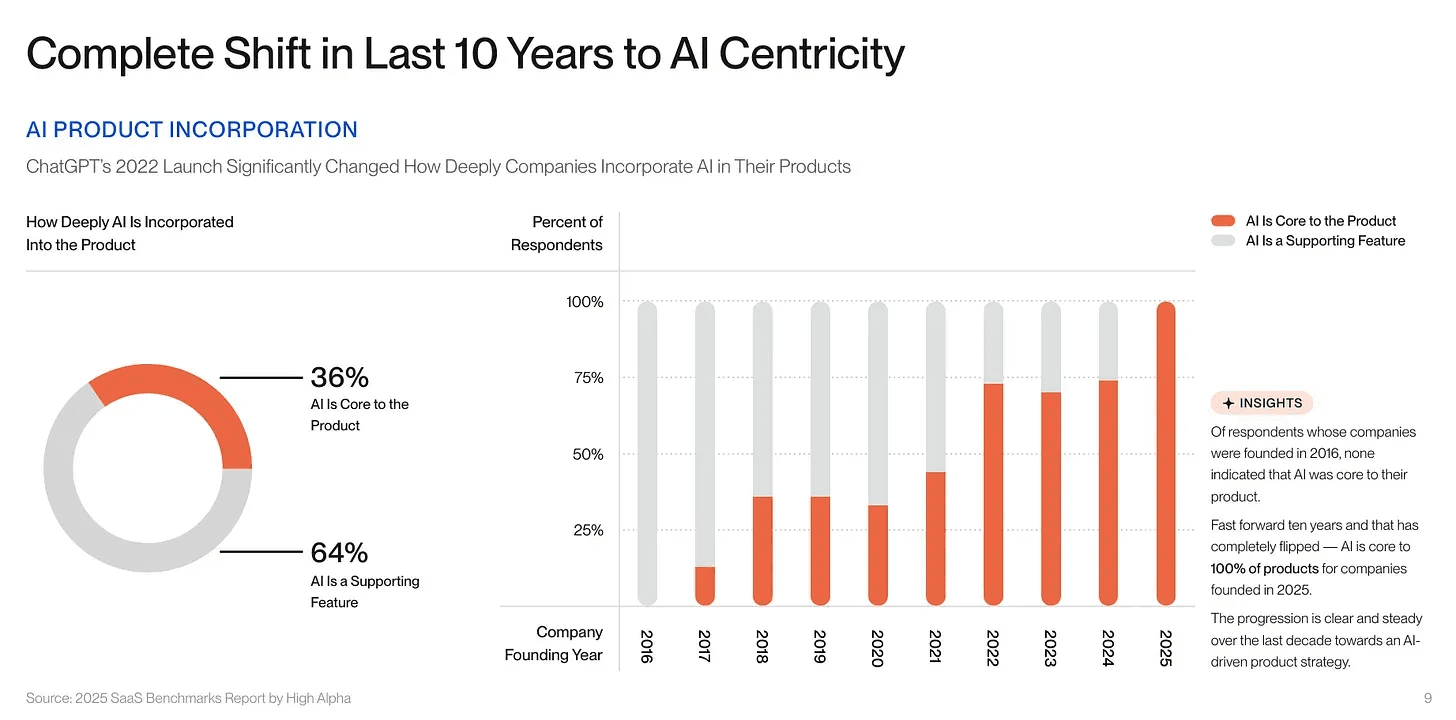
The year a company was founded is also an excellent indicator of how much its architecture is built on AI. The chart below shows AI being core to 100% of products for companies founded in 2025:

Sign up for our insights
And there’s more. AI-native companies attract top tier talent, so you know you’re working with the best. Chances are, legacy tech companies don’t have the talent required to build something truly AI-based in-house.
Plus of course, there’s the question of internal culture. With legacy tech companies, it’s very unlikely that the current management would be happy with completely tearing down what they’ve built in the last 5, 10, or 15 years, and rebuild with an AI-first mindset.
How To Know if a Potential Vendor is AI Native?
Ask one question:
If I remove the AI, does the company still function?
If the answer is yes, it’s not AI native; it’s AI decorated.
That single test separates companies experimenting with AI from those embodying it. But leaders need sharper tools to tell the difference before signing contracts or committing budgets.
Here are five questions every executive should ask before investing in AI technology:
Where does your data live, and who owns it?
True AI-native systems are built around continuous, first-party data loops. If the vendor relies on exported spreadsheets or third-party feeds, it’s a bolt-on, not a brain.
Have them show you their network architecture, literally, how data flows through the system, where models live, how feedback is captured, and how the platform actually learns. If they can’t visualize it, they don’t truly understand it.
Was the product designed for AI, or was AI added later?
Ask when the machine-learning layer was first built. If the answer starts with “recently,” you’re dealing with a retrofit. Architecture is destiny.
What decisions does the model automate today, and what has it learned this week?
AI-native companies talk in learning cycles, not product updates. If they can’t show recent evolution in accuracy, speed, or outcomes, the “AI” is ornamental.
How is your model trained and governed?
Look for proprietary training data, explainability, and model governance baked in from day one. If the vendor’s roadmap says “coming soon,” that’s a red flag.
Can your system operate if the AI layer goes offline?
If the core value remains unchanged, the AI is a marketing accessory. If the business stops learning, it’s native.
These questions reveal whether a vendor’s architecture and culture were born in the intelligence era or are merely borrowing its vocabulary.
The distinction will define the next decade of winners and laggards in retail technology.
Turning Every Transaction into a Learning Event
This is the essence of being AI native: every transaction, input, and touchpoint teaches the system something new. In legacy software, a transaction ends when the receipt prints. The system records what happened.
In an AI-native platform, a transaction begins a feedback loop. The model analyzes what was purchased, by whom, when, at what price, and under what conditions, and uses that data to refine future predictions automatically.
Every click, coupon, or cart abandonment becomes a signal.
Every price change, stock-out, or substitution becomes a micro-lesson.
Every loyalty redemption becomes a data point in understanding behavior elasticity.
Over time, the system compounds knowledge; just as Tesla cars improve with every mile driven, or Netflix’s recommendations sharpen with every stream.
That’s why AI-native businesses move exponentially while others crawl linearly. Their operating models don’t just record transactions; they learn from them.
When done right, intelligence stops being a department and becomes a reflex. Pricing learns. Marketing learns. Operations learn. Every loop feeds the next.
The flywheel spins faster and the organization gets smarter as a byproduct of doing business. That’s what separates “digital” from “intelligent.”
And that’s why architecture, not ambition, determines who wins the next era of retail.
The next decade won’t be defined by who uses AI.
It’ll be defined by who is AI.
Curious how your company can turn every transaction into smarter decisions? Reach out to our team and explore how AI-native systems make it possible.